Showing posts with label 8th Century AD. Show all posts

Sunday, 13 September 2015

Mohini

Mohini

Chalukya Dynasty,8th Century AD, National Museum, New Delhi

           In order to steal nectar from the demons, Lord Vishnu turned himself into a beautiful damsel. She entices the demons with her radiant beauty. And at the appropriate moment runs away with the pitcher of nectar. A few drops fall on earth on "Saradpurnima". The rest of the nectar is given to the gods so they can become immortals. 
           Having adorned herself, Mohini puts on the last ornament on her head, the "bendi". The mirror is the symbol of introspection.  When we introspect, we see the real self. We begin to remove our bad habits and adorn ourselves with good deeds, and with goodness. Immortality is reached when we gain higher consciousness. The nectar is within us. We merely need to snatch it away from our demons. We are all Mohinis.
          Although Mohini is an incarnation of Lord Vishnu, but it is not counted as one of his ten incarnations. Is it that we don't wish to give an important role to woman in our mythology.  Is it that woman was seen as merely enticing? Or women are seen as holder of elixir of life? Why a minor role to Mohini amongst the incarnations of Lord Vishnu? These are puzzling issues to ponder. 

Friday, 4 September 2015

Goddess Durga

Goddess Durga

Paramar Dynasty, 8th Century AD, Bhopal Museum,  M. P.

               A rather robust and full bodied Durga stands triumphantly over the still struggling  Mahisasur,  the Buffalo demon.  The battle between the good and the evil is an eternal one. Since the Gods were unable to defeat the demons, the Asuras, the contemplated together.  Their joint energy emerged in the form of Goddess Durga.  Each God gave her his weapons. Armed with the divine weapons, radiating with power and unsurpassable beauty, She allured and challenged the demons. All who fought her, perished at her feet. Although she triumphed, She is calm and serene. She displays no arrogance or emotion. She is detached from her action. While she protects the good, she destroys the evil. But like Nature she is detached from her own activities. 
            Such sculptures teach us the importance of detachment, of introspection and of serenity in our life. 

Tuesday, 25 August 2015

Lord Vishnu

Lord Vishnu

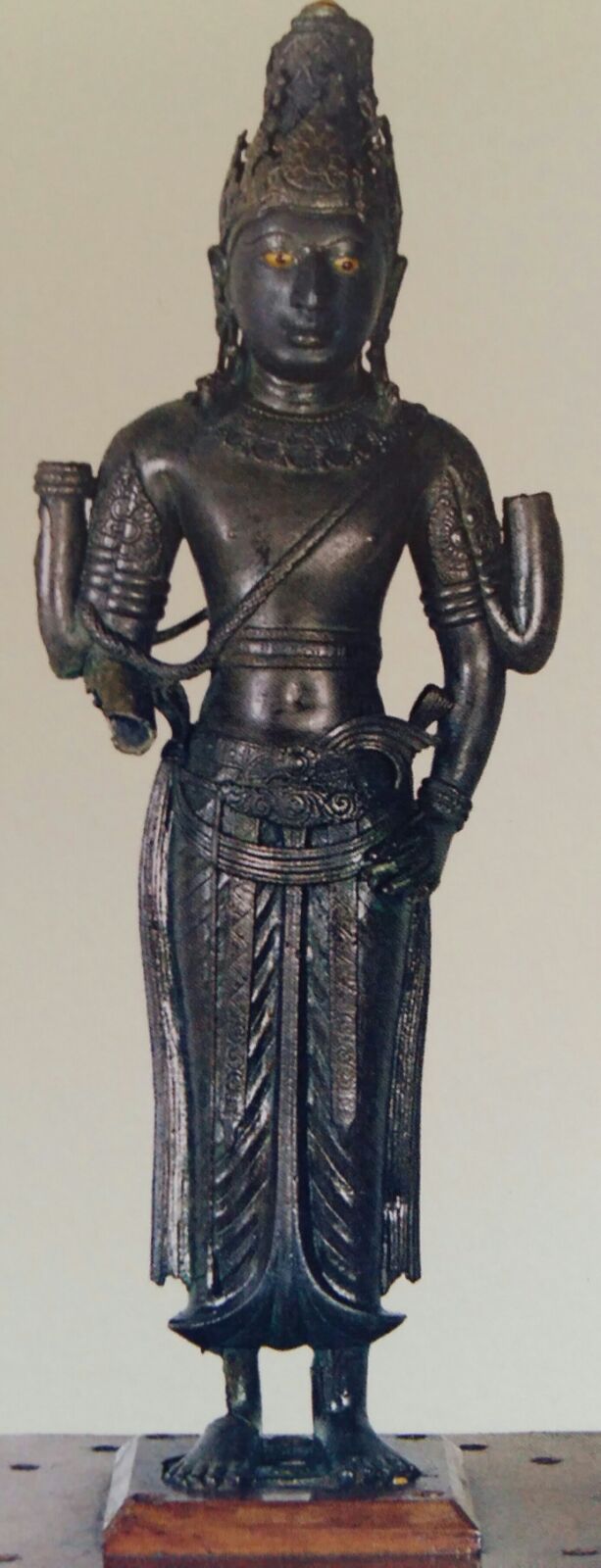
Kerala Bronze,  8th Century AD, Thiruvananthapuram Museum

             This is the oldest bronze sculpture of the museum. Although this figure is from central Kerala, it shows the influence of Pallava art of Tamil Nadu.  The eyes are done in gold and red gemstone.  There is some gold in the Crown also. 
              Lord Vishnu is an important diety in Kerala as is evident from the Padmanabhan temple in Thiruvananthapuram or Trivendrum.  Although the South has a strong following of Lord Shiva, Lord Vishnu is equally important.  
             Here we see a slender version of the male figure. While in North, Lord Vishnu is depicted as broad shouldered , and with a supple body, in South slender figures are preferred. 
This piece may not be a masterpiece,  but it is important for its historical value. 

Friday, 31 July 2015

Flying Gandharva and Apsara

Flying Gandharva and Apsara

Chalukyan Dynasty,8th Century AD,National Museum, New Delhi

          Lord Indra ' s palace is full of Gandharvas and Apsaras.  They are the musicians and the dancers of his court. They are the Hindu  counterpart of Christian angles. Like the angels they are divine beings who are closer to the gods than mortals. Man is said to be between the angels and the beast. It is up to us to ascend the ladder and become angels,  or to descend the ladder and become the beast. 
          Chalukyan art had a great influence both on Indian and Chinese Art.  These flying figures became the proto - type for divine beings both in Hindu art and in Buddhist art of China and Japan. Globalisation of Asian art began from India. 

Wednesday, 15 July 2015

Lord Ganesh

Lord Ganesh

Pratihara Dynasty, 8th Century AD, Bhopal Museum

        The name Ganpati does occur in the Rig Veda but there is no mention of Lord Ganesh in the Vedas. As a god, He emerges only in the Post- Gupta Period.  By the 8th Century, he is a popular god. His popularity continues even today. 
        Since he is depicted both as a child and as an adult, since he is a portly figure with an elephant head, he is the most caricatured of the gods. He dances and plays musical instruments, he reads and writes, he sleeps and crawls, he even sits in a rocking chair or plays cricket.  His manifestation are many. We see him everywhere and in every thing.  
        This is an unusual Ganesh for he holds a rosary and a flower in his hands. With meditation we gain wisdom ( rosary);  Wisdom is rewarded (flower). 

Sunday, 12 July 2015

Uma- Maheshwar on Nangi the Bull

Uma- Maheshwar on Nandi the Bull


Pratihara Dynasty, 8th Century AD

         Seated under a mango tree, the divine couple of Lord Shiva and Goddess Parvati,  otherwise known as Uma - Maheshwar, sit on the bull, Nangi.  They are so lost in themselves that they don't notice their two children, Kartikeya and Ganesh fighting at the bottom row. Helplessly the devotee looks at the divine couple. 
           When the God of wisdom, Ganesh symbolising creativity, and God of war, Kartikeya,  symbolising destruction,  clash with each other, we can only look at our Gods. Is this a picture of an orphaned universe, of chaos and anarchy?  Is this a political comment about its age? Or a warning to all of us about our future?

Saturday, 11 July 2015

Kamadev with Two Women

Kamadev with Two Women

Pratihara Dynasty, 8th Century AD

         Although Kamadev  (the Hindu god of Love) is depicted often in Indian miniature paintings, in sculpture he is seldom seen. Hence, this sculpture from Madhya  Pradesh is a unique one. Since love and sex was one of the goals of a Hindu life in ancient India,  it is surprising that Kamadev I'd conspicuously missing from ancient sculptures.  In contrast, for the Greeks and the Romans, Cupid (their god of love and sex ) was a popular image. Is this a reflection of hypocracy that although we may have written the first book on sex, the Kama Sutra, but publicly we will not acknowledge Kamadev? 
           Here Kamadev is being offered a glass of Soma, an ancient Indian alcoholic drink. Is the sculptor hinting at the "heady" effect of love? Is he comparing "spiritual Love" to a glass of while, like the sufi mystics do? If Kamadev  had only a single wife, Rati,  then who is the other woman sitting next to him? These perplexing questions tease us. Only to remind us that Love is an intriguing feeling. 

Friday, 10 July 2015

Natesh (Lord Shiva as a Dancer)

Natesh (Lord Shiva as a Dancer)


 Pratihara Dynasty, 8th Century AD

              The post- Gupta Period saw the resurgence of Hinduism.  Lord Vishnu and Lord Shiva emerged as two leading Gods of Hindu Trinity.  Initially called Rudra in the Vedas and Puranas, Lord Shiva was seen as God of destruction.  As Natraj (the God of Dance) he is shown doing the 'Tandav' dance (dance full of energy and dynamism), the dance of destruction itself. 
               But here He is shown in a more peaceful posture as a dancer.  He carries His trident and an axe. The trident symbolises the three states of the mind, the conscious, the sub - conscious, and the unconscious, all held by a single shaft--one mind. The axe stands for our ability to cut through the illusionary world we live in--whether it be a world we create for ourself or the impermanent world we see around us. In His lower hand, He carries a bowl--the bowl has fire, the symbol of our last destination,  cremation or liberation of the soul. The fourth hand is in 'Abhaya  Mudra' meaning "fear not." 
            Trying to  control the three states of the mind, trying to  cut through the illusionary world, trying to  liberate the soul, you have nothing to worry, once you have come to the refuge of the divinity. This is the message of the calm dancer, Natesh ( the Dancer). 

Wednesday, 10 June 2015

Dancing Ganesh

Dancing Ganesh

from Abhaneri,  Rajasthan,  8th Century AD

        Abhaneri, a town near Jaipur,  has the distinction of having the first step well of the country.  It also had beautiful temples which were influenced by Gupta art. 
        Here we see a dancing Ganesh. Whole he holds the axe, and the broken tusk, in his hands, his usual attributes,  he also holds a snake, which is rather unusual.  For snake is symbol of desires which sneak into our minds and heart. The God of wisdom knows how to control them. He rewards us with the bowl of 'ladoos' or 'modak'-- symbol of his generosity. 

Saturday, 18 April 2015

Mahadev

Mahadev

Elephanta Caves,8th Century AD

The Rashtrakuta dynasty were great builders. The Elephanta Caves, dedicated to Lord Shiva, were carved during their period. When the Portuguese came, they saw an island off the shore of Bombay, which had a sculpture of an elephant standing on the shore. Hence, the name Elephanta.
This sculpture depicts Lord Shiva in His three aspects as the creator, the maintainer, and the destroyer. He is the Supreme Being or Mahadev. The sculpture captures the eternal existence of the cosmos, where things are being created, maintained and destroyed simultaneously. The sculpture is symbolic and portrays a philosophical concept. The Europeans could not understand the deep philosophical aspect of Indian art. Seeing art from the prism of "realism", they found the Indian art as grotesque and bizzar. But these sculpture depict the essence of Indian philosophy.

Tuesday, 7 April 2015

Ravana Lifts Mt. Kailash

Ravana Lifts Mt. Kailash

Ellora Caves,8th Century AD
   Full of strength and arrogance, Ravana tried to lift Mt. Kailash, the abode of Lord Shiva. But not a pebble moved. Lord Shiva sat smiling at Ravana's childishness. Parvati, who was a bit frightened, cursed him that a woman shall be the cause of his death. In order to teach Ravana a lesson, Lord Shiva merely pressed his big toe and Mt. Kailash became so heavy for him, that he almost got burried under it. Lord Brahma and Lord Vishnu sat quietly watching the entire episode.
   Arrogance is frowned upon in every religion. For it leads to our destruction and demise. This beautiful sculpture is a reminder of human folly which thinks of no end of itself. But like Ravana we are arrogant, yet weak in front of Nature. Humility is gold, arrogance is brass.

Saturday, 21 March 2015

Durga Temple

Durga Temple

Aihole, Karnataka, 8th Century AD 


            The first set of temples were either the Stupas or the Cave temples as in Ajanta and Ellora. The Durga Temple at Aihole is the first free standing temple we have. Interestingly, its apse (the passageway for circumbulation) is built like the Vihars in Ajanta. This clearly demonstrates that the floor plan continued to be of a cave temple, but in a free standing building. The Shikhar is a small one and is disproportionate to the length of the building. But the first step to construction of a free standing temple has been taken. The rest is history.

Tuesday, 17 February 2015

The Wedding of Lord Shiva and Goddess Parvati

The Wedding of Lord Shiva and Goddess Parvati

Ellora Caves,8th Century AD
Marriage of the two was critical for the the maintenance of the universe. For, while Lord Shiva represents pure intellect, Goddess Parvati , the material world. Mind and matter had to blend.
According to Shiv Puran, Lord Brahma performed the marriage, while Lord Vishnu (with Goddess Laxmi on the left side of the panel ) acted as Parvati's brother and carried out the marriage rituals. All the gods have gathered to witness this grand wedding. This is why we celebrate Shivratri.