Showing posts with label Kerala Bronze. Show all posts

Wednesday, 26 August 2015

Marriage of Lord Shiva and Goddess Parvati

Marriage of Lord Shiva and Goddess Parvati

Kerala Bronze, 14th Century AD, Thiruvananthapuram Museum, Kerala


            A very unusual and certainly the best bronze piece in the museum. It is unusual as the theme of marriage of Lord Shiva and Goddess Parvati is not depicted even in Chola Bronze.  Chola Bronze does depict the family of Lord Shiva, but never his marriage. 
            The elegance of the pose, the gentle touch of  the hand, the beautiful facial expression, the details of the clothes worn by Goddess Parvati make this a masterpiece.  
            The social status of woman is very clear : smaller in size than Lord Shiva,  her status is lesser than his. But she is not the shy bride
            She is confident; she is radiant.   She is about to accept him as her counterpart.  But she is his equal in status. She may have longed for him. But now he is hers.  

Tuesday, 25 August 2015

Lord Vishnu

Lord Vishnu

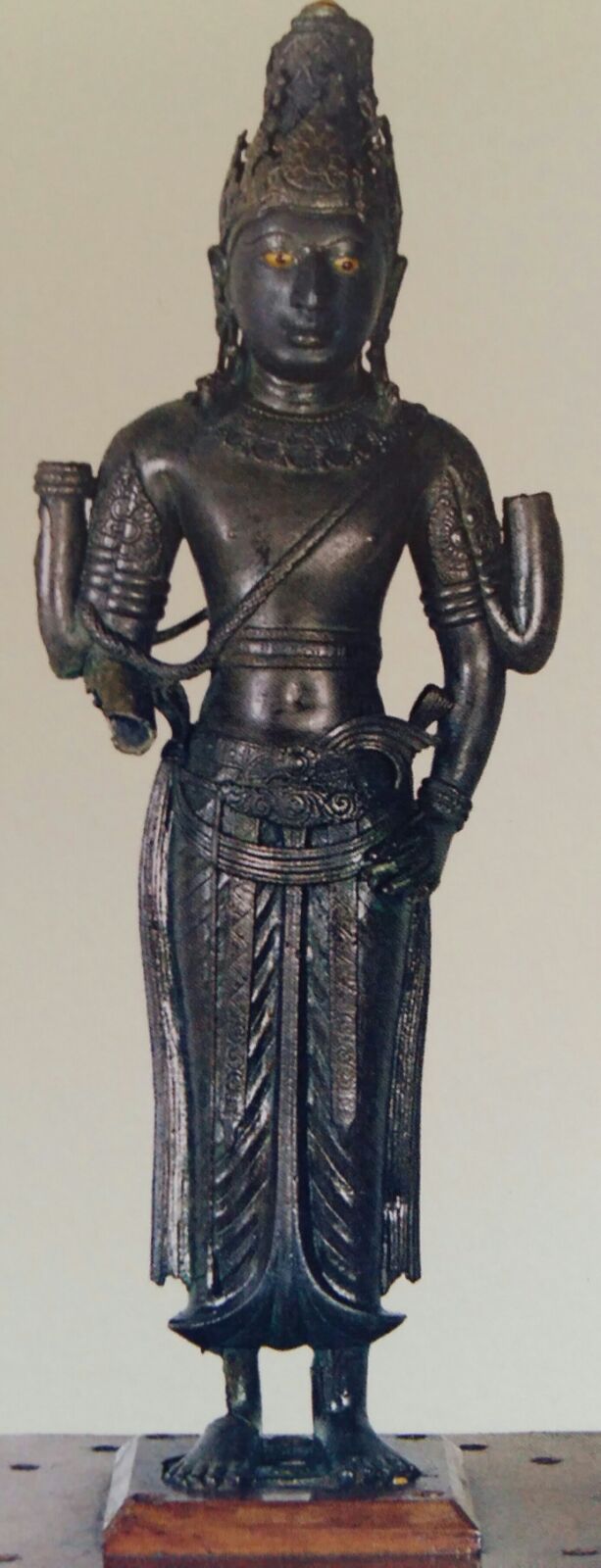
Kerala Bronze,  8th Century AD, Thiruvananthapuram Museum

             This is the oldest bronze sculpture of the museum. Although this figure is from central Kerala, it shows the influence of Pallava art of Tamil Nadu.  The eyes are done in gold and red gemstone.  There is some gold in the Crown also. 
              Lord Vishnu is an important diety in Kerala as is evident from the Padmanabhan temple in Thiruvananthapuram or Trivendrum.  Although the South has a strong following of Lord Shiva, Lord Vishnu is equally important.  
             Here we see a slender version of the male figure. While in North, Lord Vishnu is depicted as broad shouldered , and with a supple body, in South slender figures are preferred. 
This piece may not be a masterpiece,  but it is important for its historical value. 

Saturday, 22 August 2015

Lord Sastha

Lord Sastha

Kerala Bronze,17th Century,  Thiruvananthapuram Museum,  Kerala


          Lord Sastha is quite a unique figure in Hindu pantheon.  Initially, he was considered to be the son of Lord Shiva and Mohini ( the female form of Lord Vishnu ). Thus, he was the South Indian version of Lord Harihar. But subsequently and presently Lord Sastha is considered as the elder son of Lord Shiva, as a form of Skanda, the Hindu god of war. 
        The Keralites are fierce warrior. They not only worship Skanda in his form as Ayyappa, but also have war dances called, Kalaripayattu. It is a dance form where high leaps and jumps are common, where the dancer uses the sword and shields, the spear and the club. 
         But Lord Sastha is not the God of war. In this form he is seen as a teacher. Here he sits with a halo, made out of his hair. He sits in the 'Maharaja Lila ' pose or in the posture of a king.  He smiles benevolently towards the devotee,  ready to impart his knowledge of how to cope with the struggles, skirmishes and battles of life. He is the true teacher.