Showing posts with label Thiruvananthapuram Museum. Show all posts

Wednesday, 26 August 2015

Marriage of Lord Shiva and Goddess Parvati

Marriage of Lord Shiva and Goddess Parvati

Kerala Bronze, 14th Century AD, Thiruvananthapuram Museum, Kerala


            A very unusual and certainly the best bronze piece in the museum. It is unusual as the theme of marriage of Lord Shiva and Goddess Parvati is not depicted even in Chola Bronze.  Chola Bronze does depict the family of Lord Shiva, but never his marriage. 
            The elegance of the pose, the gentle touch of  the hand, the beautiful facial expression, the details of the clothes worn by Goddess Parvati make this a masterpiece.  
            The social status of woman is very clear : smaller in size than Lord Shiva,  her status is lesser than his. But she is not the shy bride
            She is confident; she is radiant.   She is about to accept him as her counterpart.  But she is his equal in status. She may have longed for him. But now he is hers.  

Tuesday, 25 August 2015

Lord Vishnu

Lord Vishnu

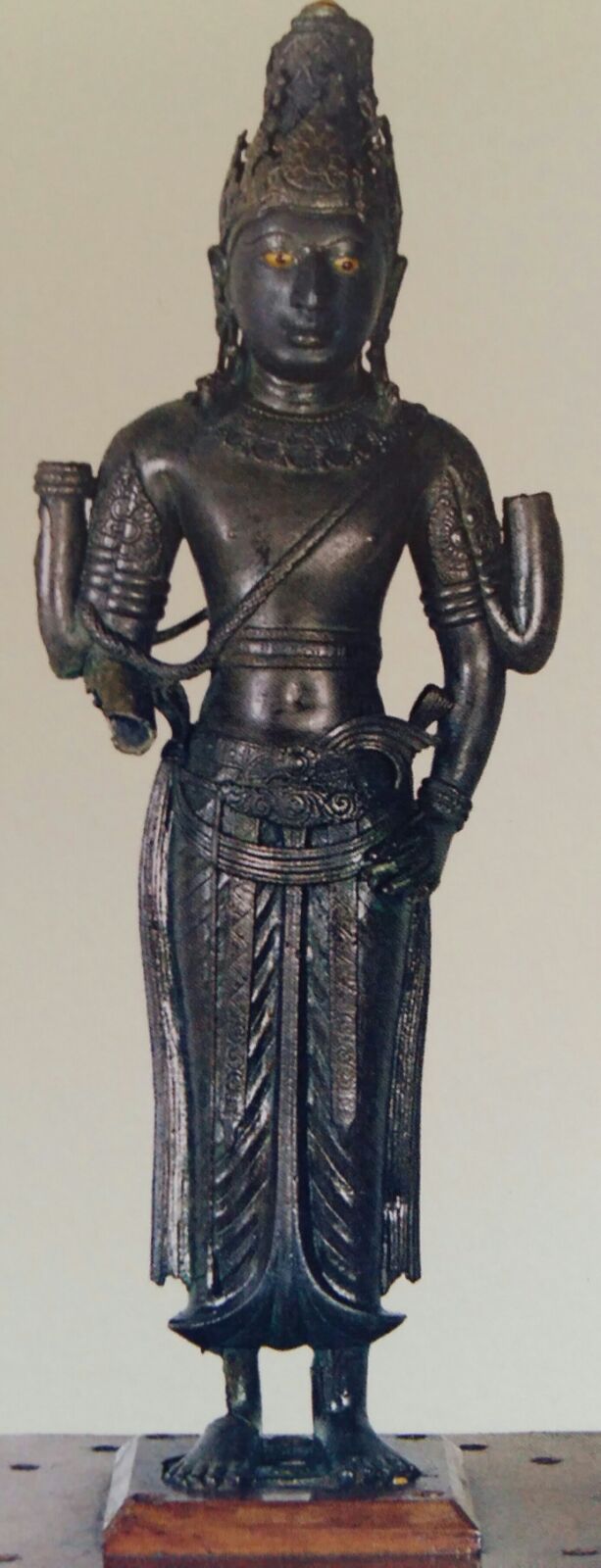
Kerala Bronze,  8th Century AD, Thiruvananthapuram Museum

             This is the oldest bronze sculpture of the museum. Although this figure is from central Kerala, it shows the influence of Pallava art of Tamil Nadu.  The eyes are done in gold and red gemstone.  There is some gold in the Crown also. 
              Lord Vishnu is an important diety in Kerala as is evident from the Padmanabhan temple in Thiruvananthapuram or Trivendrum.  Although the South has a strong following of Lord Shiva, Lord Vishnu is equally important.  
             Here we see a slender version of the male figure. While in North, Lord Vishnu is depicted as broad shouldered , and with a supple body, in South slender figures are preferred. 
This piece may not be a masterpiece,  but it is important for its historical value. 

Monday, 24 August 2015

Natraj

Natraj

Bronze Figure from South India, 18th Century AD,Thiruvananthapuram Museum, Kerala.

      Although this a bronze figure, it is unclear as to which part of South India it comes from. Whether it is a Chola Bronze or from Kerala itself, this is an issue which is ambiguous.  The fact that is claimed to be from the 18th century certainly excludes it from being a Chola Bronze for the Chola Dynasty was over by this age. 
     Despite its origin being unclear, the sculpture is lively and unique. The turn of the body, the uplifted leg make the figure come alive. It is unique as the ring of fire is not circular,  but more elliptical,  more like an arch. The figure is more delicate.  Notice the way, the fire is held between two fingers as though a flame has been plucked rather than being held in the hand. These differences clearly point to the "formulistic " usage of the posture, rather than innovating a new iconography. By the 18th century we has become imitators and we're no longer inventors. The decline had set in.

Sunday, 23 August 2015

Devi

Devi

Bronze Figure, 17th Century AD,  Thiruvananthapuram Museum, Kerala

        The Chola artist were the famous sculptors in casting beautiful bronze figures. But their techniques and influence went beyond the Chola Kingdom.  The other kingdoms of the South also picked up their concerns and iconography and made the their own. 
        This figure of the Devi is a case in point. She stands in the same pose as Goddess Parvati would have stood in Chola Bronze.  But here she holds a pair of cymbals.  Cymbals are symbols of time and rhythm.  With the instrument one marks the time (beats) and yet with sequence of beats, one creates a rhythm.  The Devi is symbolises Nature in all its benevolence.  She is Time and yet She is the rhythm of Nature. She is the Divine Mother. 

Saturday, 22 August 2015

Lord Sastha

Lord Sastha

Kerala Bronze,17th Century,  Thiruvananthapuram Museum,  Kerala


          Lord Sastha is quite a unique figure in Hindu pantheon.  Initially, he was considered to be the son of Lord Shiva and Mohini ( the female form of Lord Vishnu ). Thus, he was the South Indian version of Lord Harihar. But subsequently and presently Lord Sastha is considered as the elder son of Lord Shiva, as a form of Skanda, the Hindu god of war. 
        The Keralites are fierce warrior. They not only worship Skanda in his form as Ayyappa, but also have war dances called, Kalaripayattu. It is a dance form where high leaps and jumps are common, where the dancer uses the sword and shields, the spear and the club. 
         But Lord Sastha is not the God of war. In this form he is seen as a teacher. Here he sits with a halo, made out of his hair. He sits in the 'Maharaja Lila ' pose or in the posture of a king.  He smiles benevolently towards the devotee,  ready to impart his knowledge of how to cope with the struggles, skirmishes and battles of life. He is the true teacher.  

Friday, 21 August 2015

Lord Brahma

Lord Brahma

Chera Dynasty, 15th Century AD,  Thiruvananthapuram Museum,  Kerala

            Lord Brahma is the most neglected of the Gods of the Hindu Trinity. While Lord Vishnu and Lord Shiva are worshipped all over India, there are hardly any temples dedicated to Lord Brahma.                 According to Hindu mythology, Lord Brahma was born out of Lord Vishnu ' s navel, while the latter slept on his snake, Sheshnag.  Lord Brahma is the creator of the universe. It is said, having created, He fell in love with his creation. He chased his "daughter", wanting to have it. Seeing his arrogance, seeing his mala fide intention, Lord Shiva cut off the fifth head of Lord Brahma which used to look upwards towards the sky.
           This story, like any other myth,  is merely symbolic.  Arrogance and mala fide intention have no place in an orderly universe. Rule of Law must prevail. Even the Gods are not above "Dharma " (righteous acts). Lord Brahma has four heads in order to symbolise that a given fact  can have various interpretations. Different points of views can co-exist. This is the foundation of our pluralism and of our catholic world view.

Wednesday, 19 August 2015

Lord Ganesh

Lord Ganesh

Chola Bronze, 11th Century AD, Thiruvananthapuram Museum

 
          Recently visited the Government Museum at Thiruvananthapuram. Although the Museum has an excellent collection of Chola Bronze,  but the collection is hopelessly displayed. There are even mistakes about the identity and importance of the images of the Gods of Hindu pantheon.  This figure of Lord Ganesh is described as holding a "horn" in his front right hand. Wish they knew it is a broken "tusk" which He holds and not a "horn". 
          The image is a beautiful one with Lord Ganesh standing on a lotus pedestal. Since the sculpture was meant to be carried,  it has two prongs on the side. Images of the Gods are still carried in many parts of the country so as to permit the devotees to have a glimpse (a darshan) of the Gods. It is also a social means of conveying that all is well in the city. Such social festivals not only permit us to be together, but also allow us to celebrate the joys of life, itself.